What does it mean when a provider says that they "accept insurance"?
We see this all over the place, in signs outside of urgent care to advertisements in commercials for prescription drugs. Companies in the digital health community spend a lot of time fretting over whether their product will be "accepted by insurance". Physicians hoping to open their own practice will say that one of their greatest challenges is figuring out how to accept insurance.
When patients go to get care, their top priority is usually going somewhere that "takes my insurance". People will suffer long phone wait times, horrible user interfaces, and limited selection of providers just to make sure that they go to a provider that "accepts insurance".
And still, they will find that quite often, the appointment that they carefully scheduled wasn't fully covered by their insurance and the remaining bill is illegible.
So, where did the system break down?
The system broke down near the beginning, when the patient assumed that it was the provider accepting the insurance.
This is not what happens. What really happens, is that the provider submits a claim to the insurance plan and then then insurance plan decides how to pay the claim based on adjudication rules in its policy document.
The provider generally cannot "pre-guarantee" that your insurance plan will pay for something. For obvious reasons -- they haven't read your plan document. They might not have access to other information relevant to paying your claim (like your previous claim history, what benefit categories your plan pays, what prior-authorization your plan had in place).
A simple example: your might find an in-network provider that will accept you for an annual well-visit (which is guaranteed to be covered once per year by every ACA-compliant health plan). But, your insurance plan might deny your visit if you had been to a different well-visit within the last 12 months.
When a provider says "we accept insurance", what they actually mean is "we feel like we have a high enough likelihood of getting your claims paid that we will see you and only bill your copay, assuming the financial risk that the insurance company does not pay us the rest of the amount".
Of course, they still reserve the right to bill you (the member) the full amount that your insurance plan does not cover.
So, what actually happens? Explain it to me like I'm five.

The above picture is how health insurance was designed to work, used to work, and how every other category of insurance works.
You go get service, you get a bill, you have to submit that bill to insurance and your insurance company takes that itemized bill and compares it to your policy's benefits and sends you a check for what the plan covered.
There are problems with this model. The member may not have enough money to pay the whole bill. The member may have difficulty submitting the claim, since this kind of paperwork is tricky and not all people have the skills to do it.
But, this kind of model keeps members aware of what their policies actually cover and gives them them hopefully more advance notice of what things will cost since the provider will interact directly with the member.
This is sometimes called "indemnity" insurance since it indemnifies the member.
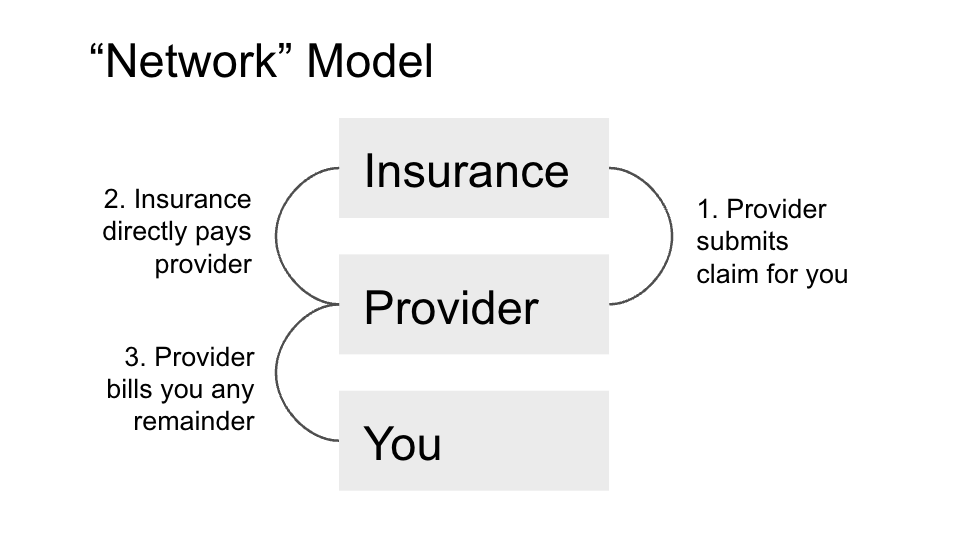
The above picture is how most people experience healthcare. They generally let their doctor (or their doctor's outsourced supahightech billing consultant) submit claims on their (the patient's) behalf.
This adds customer service value to the patient, in theory, who would rather not go through the process of submitting a claim to their insurance plan.
In practice, this creates MULTITUDES of bad incentives.
Consumer prices don't exist in this model since "price" isn't something the consumer actually cares about.
Insurance providers can each negotiate different prices for the same service from the provider. And, since consumers never see these prices, they can stay hidden and (until recently) completely obscure.
Dishonest providers, or more like their outsourced supahightech billing departments, can exaggerate ("upcode") performed procedures. Since the member does not get the bill directly, they might not notice the fraud.
Consequences
The interesting thing is that even though the way people pay for healthcare typically follows the "Network" flow above, legally it follows the "indemnity" model. Which is why you owe your provider for an unpaid bill, despite you not seeing the bill until after it was adjudicated by your insurance company behind your back according to secret network contracts between your doctor and your insurance plan.
Makes sense, right?
The advantage of this is that technically the network model is "backwards compatible" with the original transparent model. This has advantages for innovative plans hoping to get members back in control of the bills they pay for healthcare.
Two important facts:
Every provider and medical service must have a cash price, and this price can't depend on whether or not the person receiving care has insurance.
Insurance has the freedom to reimburse or prepay for care for members who get care outside of a network.
The future?
The network system is breaking down. Members don't feel like the status of being "in network" guarantees them the predictability and service that it used to.
Providers are also feeling severe administrative burden. They have to jump through unreasonable hoops just to submit claims to insurers that might not even reach a member's deductible.
Members and providers are responding by organizing transactions in cash, again, skipping the insurance networks that serve as middlemen.
An optimistic view of the future is that an insurance plan provides clear guidance on how much members can spend (and on what) in the cash-pay healthcare economy.
Members would then have both the predictability of the "network model" with the price transparency and freedom of the original indemnity model.
And the "network negotiators" in between? There would be fewer of them.