Imagine you fall down the stairs, break your arm, and get rushed to the E.R. After a few hours of treatment, you leave with a cast, a prescription for pain meds, and, because this is the United States of America, the fear of a $25,000 medical bill that’s coming to you in the mail.
Luckily for you, in 2020, Congress decided to pass the No Surprises Act, a bill protecting patients from unexpected medical bills when they receive care from out-of-network providers in situations they didn’t choose or couldn’t reasonably avoid (e.g. emergencies). That means that instead of being charged $25k, you (and your health plan, if cost-share applies) will only be charged a fraction of that cost. That fraction is called the Qualifying Payment Amount (QPA) and represents what a median in-network rate would be for the same service in the same facility in the same place.
The NSA is the legislation that solves one of the worst healthcare billing problems in the country. Patients avoid crazy bills; health plans have a standard way to calculate provider payments. It’s almost too good to be true.
Reality, like it often does, paints a different picture. QPAs are difficult to calculate and harder to verify. Providers and plans use third-party vendors to debate payment amounts instead of engaging in a legitimate exchange between affected parties. The dispute process is expensive, detached from real pricing data, and skewed toward providers.
These unintended consequences of the NSA have made the legislation fail to live up to its noble mission. Between 2022 and 2024, the NSA generated an estimated $5 billion in additional healthcare costs. In 2025 alone, that number tripled. Yet, rising provider payouts only make up a portion of the money going to NSA benefactors. The rest goes to the third-party arbitrators settling NSA cases between plans and providers, some backed by private equity. In the first two years of the NSA, the CMS and these entities pocketed around $1 billion in administrative costs. While patients now avoid the pain of surprise billing, it’s only a matter of time until they bear the burden of the NSA in the form of higher insurance payments.
Six years since its inception, the failure of the legislation has been extensively covered in the media as yet another example of a well-intentioned, poorly-executed law in the opaque world of health insurance. This article aims to offer a perspective we feel has been missing: a first-hand account of what we’ve learned from managing the NSA process on behalf of health plans.
What most Third-Party Administrators have outsourced to legal firms, Yuzu has done in-house. We’ve chosen to put ourselves at the front lines of disputes with providers to assess whether or not we could intervene in the gnarly NSA cycle with transparency, good faith, and hard data.
Unfortunately, we’ve mostly failed and we’ve come to the conclusion that this is by design. The NSA wasn’t properly set up for success. It’s a microcosm of all the ambiguity that makes people hate compliance: unclear definitions, misaligned incentives, and reliance on actors being well-behaved without mechanisms to enforce good behavior. We care about what’s wrong with the NSA — and so should you — because it epitomizes what’s wrong with health insurance law as a whole.
The Basics
To put you in our shoes, we’re going to walk you through what it’s like to engage with the NSA dispute process from beginning to end.
The process has three stages.
A “provider” (a.k.a. the vendor they pay to negotiate on their behalf) will email us to begin Open Negotiations if they’re unhappy with our QPA.
If no settlement is reached after 30 days of negotiations, the provider may initiate Independent Dispute Resolution (IDR), a “baseball-style” arbitration process where a third party picks either the provider’s or health plan’s payment offer.
Once a payment determination is made in IDR, the losing party has 30 business days to pay the winning party the selected amount.
We’ll go into detail about each of these stages, but want to first shed light on the unique position Yuzu plays in this process. Yuzu doesn’t charge any additional fees for supplying NSA dispute services — we consider it part of our standard PEPM, rather than a tacked-on cost. In fact, we overall lose money on engaging with NSA disputes. IDR entities (IDREs) charge an admin and entity fee. The admin fee is $15 (previous to June 2026, it was $115 dollars) and the entity fee ranges from $200-$1100, which is only refunded if we win the dispute. Instead of charging the plan, Yuzu pays all these fees ourselves.
We’ve been advised against this business model, one where we have no control or expected cap over expenses, but we don’t like to nickel and dime our partners for ridiculous fees. As a result, we have every incentive to correctly calculate a QPA under NSA regulations and avoid provider disputes in the first place.
What’s in a QPA?
Before we ever receive an Open Negotiation Notice for a claim, we mail the provider an Explanation of Benefits with the plan’s allowed payment amount — in other words, the QPA. Despite our frustrations with the NSA, we’re ultimately very invested in offering fair pricing to providers. This is part of the reason we keep the NSA process in-house; doing so allows our negotiations and disputes to stay rooted in pricing data. If a provider emails us to negotiate a payment and we agree that the price seems too low, we can go back to our claims team and investigate it.
One of the greatest challenges with the NSA is that there’s no standard for calculating a good QPA, even though it initially seems like there is. The DOL defines the QPA as: “the median of the contracted rates recognized by the plan for the same or similar item or service that is provided by a provider in the same or similar specialty or facility of the same or similar facility type and provided in the same geographic region in which the item or service under dispute was furnished, increased by inflation.”
CMS provides no guidance on what exact data to use to calculate the QPA and even explicitly rejects using Medicare to anchor QPA values, leaving every plan to develop their own methodology. Medicare rates are the federal government’s own standardized fee schedule — a consistent, publicly available number that could have made QPAs easy to compare across plans. Without that anchor, each insurer’s QPA is essentially self-reported. Definitionally, asking plans to use a “median” rate means that they will always offer providers a lower sum than 50% of all pooled in-network rates. The result is that half of providers will inherently be unhappy with the QPA because they get paid more in-network. (It’s also worth noting that many providers have in-network rates that are never actually billed, which potentially skews the median to numbers that are too low.)
Calculating a “fair” QPA broaches an age-old question in healthcare pricing: how can we determine how much a healthcare service is worth?
Let’s say we get an Open Negotiation Notice from a provider who billed $29,404.98 for an injection and $8,967.40 for an imaging guidance, for a combined submitted charge of $38,372.38. The plan’s network prices an equivalent service in the same region at $90.41 and $46.17 respectively, for a total allowed amount of $136.58. There’s an enormous discrepancy between these two sets of rates. Which one is more fair?
In investigating this question for a particular claim, we’ll usually start by trying to find similar internal claims to serve as benchmarks. If we don’t find any, we’ll reference third-party sources for their median in-network rates. Unfortunately, each dataset is unique. For similar services in similar regions, Turquoise might say median in-network contracts show rates of $230 and $140, different from both our QPA and the provider’s billed amount. At this point, we could turn to the CMS public use files for answers. But the files don’t contain relevant claims fields like billing type, units, and modifiers that would dramatically change reimbursement standards for these procedures. Without a clear picture for what a QPA should be, we’d be left to check the median IDR award for these services. For the services mentioned above, that median was a staggering $12,000 total in 2025.
Given the QPA’s ambiguity, we’d hope for the negotiation and dispute process to help plans and providers arrive at a shared understanding of how the claim got billed and got priced. Instead, it’s detached from the pricing data behind it.
Open “Negotiations”
From our perspective, Open Negotiations are a chance to determine what a fair reimbursement is for a given service, which includes evaluating whether we calculated a reasonable QPA. Our hope is to work with providers to ensure we understand the service they provided to the patient and what they would have billed for it if it were in-network. Often, we’ve emailed providers honestly asking for their in-network rates and how other plans have priced their QPAs.
We’ve found that providers seldom engage with our questions. We’re often met with a string of robotic replies that a provider will send over and over on the same chain: “We received and reviewed your offer and found that the amount offered is still below our expectations, so we had to reject it.”
Funnily enough, we’re actually happy to get a response no matter how bad it is — we usually get ghosted. Often, the next time we hear from providers after their Open Negotiation Notice is when they tell us they’re initiating IDR.
So, “negotiations” is a generous term for our typical exchanges with providers. But why are negotiations so non-negotiable? Are plans so unreasonable that providers see IDR as the only route forward? Is Yuzu so unpleasant that people don’t want to email us back? Obviously, we can’t give you objective answers and encourage you to talk to our customers. But what should be concerning to you regardless is how chillingly unproductive the negotiations experience can be. It quickly starts to feel like an exercise of throwing random numbers out, rather than plans and providers working together to validate reasonable payments.
This is probably a symptom of negotiations getting outsourced. Roughly 80% of Open Negotiation Notices we receive come from third-parties rather than directly from providers. Many plans also use their own third-parties to handle negotiations and disputes. One explanation for this is that providers have too much on their plate and don’t have time to dispute claims. While this would be understandable, the result is harmful; third-parties are detached from the actual healthcare services and cannot reliably explain why they demand the prices they do.
The House Always Wins
If we don’t manage to settle during open negotiations, providers jump at the opportunity to take the case to IDR. It’s in their best interest to do so — according to CMS, in the last six months of 2025, providers won a staggering 84% of nondefault dispute decisions.
When IDR is initiated, we pay the aforementioned admin and entity fees. If we lose, the plan we’re representing must pay the determined amount directly to the provider within 30 calendar days.
It’s Yuzu’s self-funded plans that bear the cost of IDR determinations, and sometimes, on claims where the awarded amount is so disproportionate that paying it would conflict with ERISA's prudence requirement for spending pooled resources responsibly, the plans we support choose not to pay them. We’ve never seen one of these determinations actually enforced or seriously pursued, despite non-payment. Anecdotally, this is becoming a common pattern in the industry.
The question of enforceability has gone up the legal ranks, but ultimately the Supreme Court decided not to review a case where the Fifth Circuit ruled that the NSA does not grant providers a private right to action to sue a plan for nonpayment. Essentially, there’s no legal basis to enforce IDR awards in court.
For this reason, in July 2025, the No Surprises Enforcement Act was introduced to Congress which would add higher penalties for nonpayment of IDR final determinations. But it’s hard not to scoff at the idea of adding yet another punishment for health plans in the NSA process — IDR is already a losing game that plans pay to play. There’s also no good evidence that providers are winning the majority of disputes because plans are systemically underpaying. The Brookings Institution’s analysis of 2023 data found that the prices emerging out of IDR for emergency services averaged 4 times what Medicare would pay. Another analysis of 2025 CMS data by the Niskanen Center showed that provider awards in IDR for specialty services are coming out to 15 to 25 times their respective in-network benchmarks.
Even worse, not every IDR entity makes the same determinations. Our internal analysis of 2025 CMS files found that five IDREs sided with providers in 90% or more cases, while one IDRE only sided with providers in half of cases. There doesn’t seem to be a standard among IDREs for final determinations, further calling into question the fairness of the resolution process. Since IDREs aren’t asked to determine whether the QPA was calculated correctly or check its merits, there isn’t one, objective framework by which to judge each party’s offer.
Usually, when we submit our final payment offer, we include a supplemental document defending why we believe our price is fair. We explain the data we used to calculate the QPA and reference standard in-network rates. In the most obscene cases, we’ve stated that we think the provider who initiated IDR is abusing the NSA for higher payment. We cite their unwillingness to negotiate with us, their repetitive emails that lead us to believe they initiate IDR on every claim no matter how much they’ve been paid, and their objectively insane billed amounts. Think $8,700 for a basic nerve-function check, or $14,000 for a CT scan. All numbers we’ve seen make it to IDR.
But we’re no grand exception to the national statistics — we lose IDR a lot. Final payment determinations have to state why they sided with the winning party, but those descriptions are formulaic and templatized, lacking specific evidence that explains their reasoning (example below of a dispute we lost).
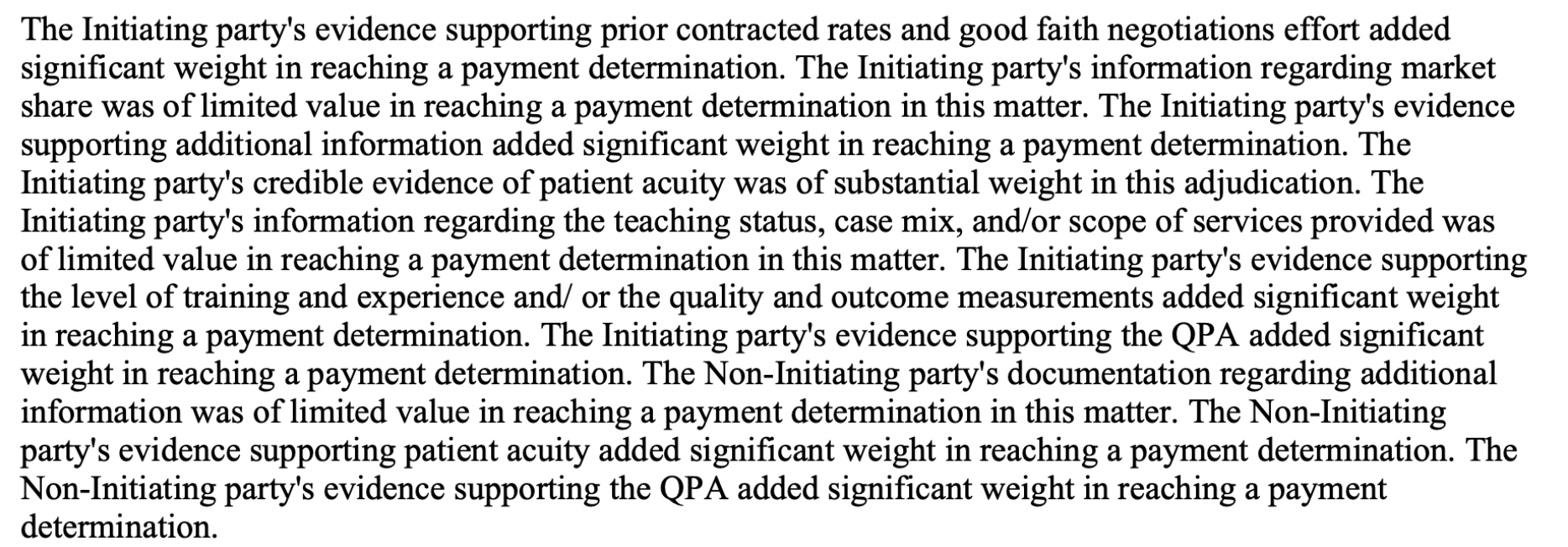
Even if an IDRE wanted to choose an offer that fell somewhere in the middle of ours and the provider’s, they wouldn’t be able to. The NSA forces IDREs to choose: plan or provider. It does not ask them to come up with what they think is fair, only to make a choice between the plan’s QPA and whatever number the provider chooses to submit.
What We’ve Learned from Losing
If you didn’t know it already, you do now: the No Surprises Act is surprisingly bad. The ambiguity of the legislation leaves plans to develop their own QPA methodology instead of all working with the same dataset, giving providers no reason to take offered payments as fair values. Moreover, it makes no sense for providers to accept QPAs given how much they stand to win at IDR.
Because providers have the power to initiate IDR and plans are forced to comply, IDREs also have business incentives to let providers win. The better the resolutions are for the provider, the more cases go to IDR, and the more entity fees they get paid. Indeed, the vast majority of disputes are initiated by providers, which makes sense — there’s no good reason that a health plan will dispute its own QPA amount (our analysis shows health plans initiated IDR less than 1% of the time in 2025). The third-party representatives that negotiate on behalf of providers also have every incentive to dispute as many NSA claims as possible, given they make a living on taking cases to IDR that they’re almost guaranteed to win.
Further, the NSA's nonenforceability makes compliance difficult for providers and members alike. We've spoken about plan-provider disputes in this article, but the other side of the NSA is patient-provider dispute resolution (PPDR), where self-pay patients can challenge bills that come in higher than their original good faith estimates. Yuzu handles PPDR disputes on behalf of its members and has won every case so far. Yet even a favorable determination isn't necessarily the end of the story: enforcement rests entirely with the Department of Health and Human Services, and there’s no public data on whether or how often HHS actually follows through on these determinations. The same structural gap that plagues the plan-provider IDR process affects patients, who have no independent way of imposing compliance.
We’ve tried every strategy in our handbook to outplay the NSA, but we can’t win a rigged game. CMS is starting to take notice of the same thing; just recently, their spokesperson publicly admitted, “The system is being gamed to get higher prices.” The solution to this — transparency — is the same solution to most problems in the health insurance space. Yuzu practices this by explaining to providers why and how we pay what we pay, and we expect providers to be capable of reciprocating. If the NSA becomes more transparent and less ambiguous, it could fulfill its original mission of protecting members without ballooning costs. That’s a resolution worth pursuing, not just for the NSA, but as a blueprint for an industry that plays by the same broken rules.