

Overview
When an employee takes an extended leave of absence, employers must determine how long the employee can remain covered under their health plan. Maintaining coverage beyond the permitted eligibility period, or failing to document continued eligibility, can create problems when seeking stoploss reimbursement.
This determination involves three separate documents:
Employee Handbook: Establishes the employer's leave policies, including available leave types, duration, and whether leave periods run concurrently.
Plan Document / Summary Plan Description (SPD): Defines health plan eligibility, how long coverage continues during leave, and when coverage terminates.
Stoploss Contract: Determines whether claims incurred during leave are eligible for reimbursement under the carrier's policy.
An employee may be entitled to continued health coverage without every associated medical claim necessarily qualifying for stoploss reimbursement.
Health Coverage During FMLA
The federal Family and Medical Leave Act (FMLA) provides eligible employees with up to 12 workweeks of job-protected leave during a 12-month period for qualifying family and medical reasons. Certain military caregiver situations allow up to 26 workweeks.
Federal FMLA generally applies to private employers with at least 50 employees for 20 workweeks in the current or preceding calendar year, as well as public agencies and elementary or secondary schools. Employees must generally have worked for the employer for at least 12 months, completed 1,250 hours in the preceding 12 months, and work at a location with at least 50 employees within 75 miles.
During qualifying FMLA leave, employers must maintain group health coverage under the same terms and conditions as if the employee were actively working.
Employer contributions: Employers must continue paying their normal share of health plan premiums.
Employee contributions: Employees remain responsible for their normal share of premiums, including during unpaid leave.
Employers should establish payment arrangements when payroll deductions are unavailable. Under federal FMLA rules, coverage may generally be discontinued if an employee's payment is more than 30 days late, subject to applicable notice requirements and any longer employer grace period.
Important Note for Stoploss: Employers should maintain records of employee contributions, payroll deductions, and payments collected during leave, as stoploss carriers may require proof of premium payments when reviewing reimbursement requests.
What Happens When FMLA Ends?
When FMLA leave is exhausted, the employer's obligation to maintain coverage under FMLA generally ends. Whether coverage continues depends on other applicable laws and the health plan's eligibility provisions.
The employee returns to work: Coverage continues as normal.
The employee moves to another approved leave: Examples include company-provided medical leave, leave associated with short-term disability benefits, or state-protected leave. Coverage may continue as permitted by the SPD and employee handbook.
The employee does not return: Employers should review when coverage terminates under the SPD and whether COBRA must be offered.
Example: Maria's FMLA leave ends on March 31. Her Employee Handbook permits up to 90 additional days of unpaid medical leave. If the SPD also permits continued health coverage during those 90 days, and the stoploss contract recognizes that coverage, Maria's claims in April through June may remain eligible for reimbursement. If only the Employee Handbook mentions the additional coverage, the carrier may question her eligibility after March 31.
When Leaves Overlap
An employee can qualify for more than one type of leave at the same time. This includes federal FMLA, state family or medical leave, paid sick time, company-provided leave, or an absence associated with short-term disability or workers' compensation.
An important consideration is whether these leave or coverage continuation periods run concurrently or consecutively:
Concurrent: Leave or coverage continuation periods overlap, so the same period of time counts toward multiple applicable entitlements or benefits.
Consecutive: One period begins after another ends, potentially extending the total duration of leave or continued coverage.
Employers have flexibility in determining whether additional company-provided coverage continuation runs concurrently with other leave periods or begins afterward. For example, an employer may structure its 90-day continuation period to overlap with FMLA or begin after FMLA ends, depending on the plan's terms.
Setting the Concurrency Election
This election is made during onboarding through the portal and is recorded in the employer’s group policy, within the ‘Enrollment’ section:
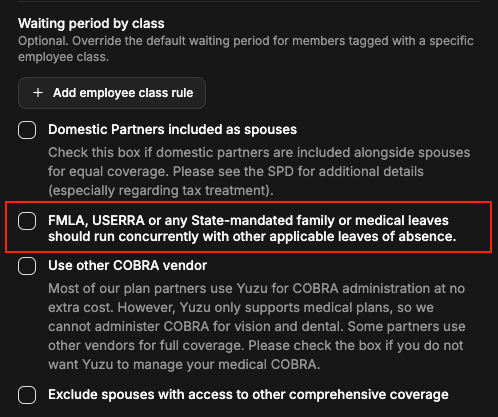
The election flows from the group policy into the SPD, so it should be confirmed during onboarding and should match the leave rules described in the Employee Handbook.
Aligning the Employee Handbook and SPD
Inconsistencies between the Employee Handbook and SPD can create coverage eligibility disputes. Even if an employer continues providing coverage during extended leave, the stoploss carrier may question reimbursement if the employee is no longer eligible under the SPD.
Employers should review the following:
Leave duration: How long can an employee remain on approved leave?
Coverage duration: How long does the SPD permit continued health coverage during that leave?
Concurrent leave: Do the Employee Handbook and SPD describe consistent rules for overlapping leave and coverage periods?
Premium payments: How are employee contributions collected and documented during unpaid leave?
Coverage termination: When does active coverage end, and when are applicable continuation coverage rights offered?
Employers should work with their broker or benefits counsel to resolve any inconsistencies and confirm that their coverage continuation provisions are consistent with the stoploss contract.