
Scope
Applies to Medicare beneficiaries with coverage through an employer-sponsored Group Health Plan (GHP), either through their own employment or that of a spouse or family member.
How to use this guide
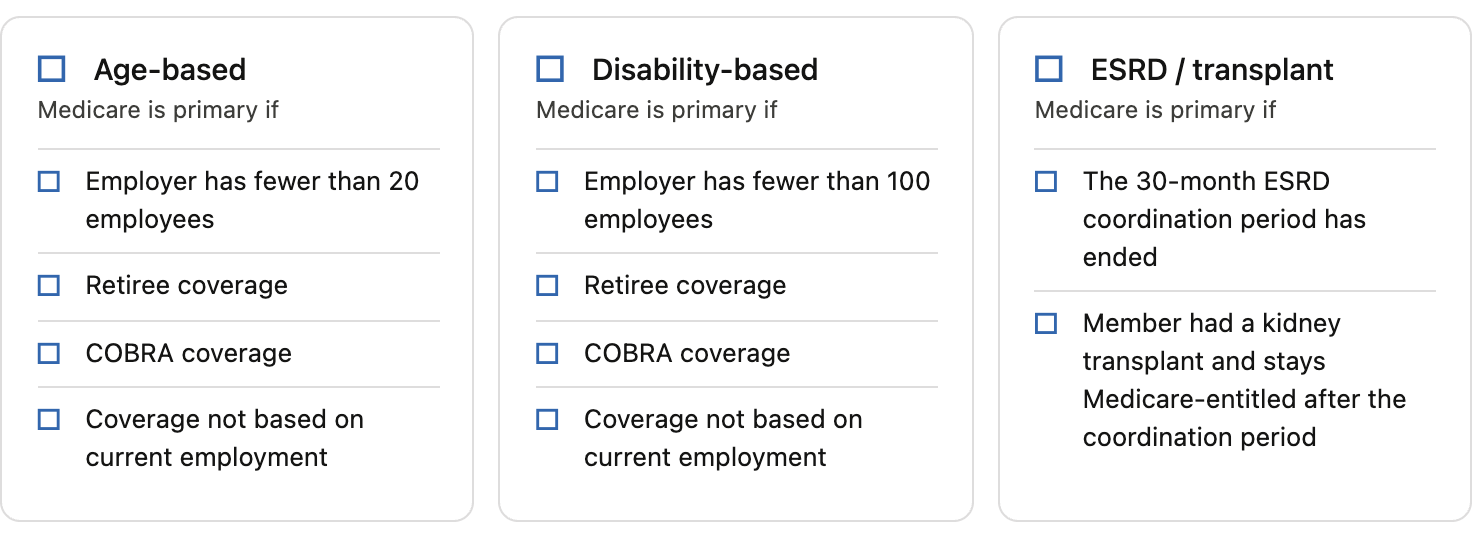
Work top to bottom: first identify why the person has Medicare, then how their GHP coverage is held, then (if it's based on current employment) the employer size. The decision tool above walks you through this for a single member; the tables below are the authoritative reference to verify against. Employer size is confirmed from the tax info on the group's settings tab.
Step 1: Identify the basis for Medicare entitlement
Determine whether the beneficiary qualifies for Medicare due to: age (65 or older); disability (under age 65); or End-Stage Renal Disease (ESRD).
Step 2: Determine employment status and coverage basis
Verify whether the GHP coverage is based on the current employment of the beneficiary (subscriber) or the current employment of a spouse; whether it is retiree coverage or COBRA; and the employer size (number of employees).
Step 3: Apply Medicare Secondary Payer (MSP) rules
A. Medicare due to age (65 or older)
Situation | Primary payer | Notes |
|---|---|---|
Beneficiary actively employed, employer ≥20 employees | GHP | Coverage through subscriber |
Beneficiary actively employed, employer <20 employees | Medicare | Coverage through subscriber |
Spouse actively employed, employer ≥20 employees | GHP | Coverage through spouse |
Spouse actively employed, employer <20 employees | Medicare | Coverage through spouse |
Retiree plan | Medicare | Applies to subscriber or spouse |
COBRA | Medicare | Applies to subscriber or spouse |
Coverage not based on current employment | Medicare | Applies to subscriber or spouse |
B. Medicare due to disability
Situation | Primary payer | Notes |
|---|---|---|
Beneficiary actively employed, employer ≥100 employees | GHP | Coverage through subscriber |
Beneficiary actively employed, employer <100 employees | Medicare | Coverage through subscriber |
Spouse actively employed, employer ≥100 employees | GHP | Coverage through spouse |
Spouse actively employed, employer <100 employees | Medicare | Coverage through spouse |
Retiree plan | Medicare | Applies to subscriber or spouse |
COBRA | Medicare | Applies to subscriber or spouse |
Coverage not based on current employment | Medicare | Applies to subscriber or spouse |
C. Medicare due to End-Stage Renal Disease (ESRD) / kidney transplant
ESRD coordination period: Medicare rules include a 30-month coordination period, during which the GHP pays primary regardless of employer size.
Situation | Primary payer | Notes |
|---|---|---|
Within 30-month coordination period | GHP | Applies to subscriber or spouse coverage |
Kidney transplant during 30-month coordination period | GHP | GHP remains primary for the remainder of the 30 months |
After 30-month coordination period | Medicare | Medicare is primary, GHP secondary |
Kidney transplant after coordination period | Medicare | Medicare remains primary |
Medicare coverage after kidney transplant:
Medicare generally continues for 36 months post-transplant if ESRD-based entitlement was the only reason for coverage.
After 36 months, Medicare ends unless the individual qualifies due to age or disability; the GHP becomes sole payer.
Employer size does not affect ESRD or post-transplant determinations.
Coverage through a subscriber or spouse is treated the same.
Examples:
A beneficiary gets a kidney transplant 12 months into the ESRD coordination period; the GHP remains primary for the remaining 18 months.
A beneficiary gets a transplant after the 30-month coordination period; Medicare is primary.
A beneficiary reaches the end of the 36-month post-transplant period without other Medicare eligibility; the GHP becomes sole payer.
Quick reference summary