

What is the No Surprises Act (NSA)?
The NSA protects patients from unexpected medical bills when they receive care from out-of-network providers in situations they didn’t choose or couldn’t reasonably avoid (e.g. emergency services). Under the NSA, when a participant gets a surprise bill from an out-of-network provider, their cost-sharing is based on the Qualifying Payment Amount (QPA), not what the out-of-network provider billed.
According to CMS, “the QPA is the median of the contracted rates recognized by the plan for the same or similar item or service that is provided by a provider in the same or similar specialty or facility of the same or similar facility type and provided in the same geographic region in which the item or service under dispute was furnished, increased for inflation.”
Yuzu Health’s QPA methodology for each claim is in line with the above, using Serif and Cigna datasets of contracted rates depending on the plan’s network.
How are NSA-eligible claims negotiated?
When an out-of-network provider disagrees about the payment offered on the EOB, they may initiate negotiations with the plan. Open negotiations must be initiated within 30 days of payment or denial of payment, and may last for 30 business days.
If the provider and plan don’t reach a negotiated rate by the end of the 30 days, the provider may initiate Independent Dispute Resolution (IDR). During the IDR period, each side submits a final payment offer to a certified IDR entity, and the arbiter picks one.
When IDR is initiated, the plan pays both an admin fee of $115 and an entity fee, which can range from $200-$800 for single determinations and $268-$1,173 for batched determinations. If the payment determination sides with the plan, the entity fee is refunded. If the payment determination sides with the provider, the plan must pay the determined amount directly to the provider within 30 calendar days.
Does Yuzu handle Open Negotiations and the IDR process?
Yes. Yuzu is responsible for fairly negotiating during the Open Negotiation period and putting the plan’s best foot forward during IDRs. In addition, Yuzu covers IDR admin and entity fees. See our flowchart below about Yuzu’s NSA negotiation and IDR process.
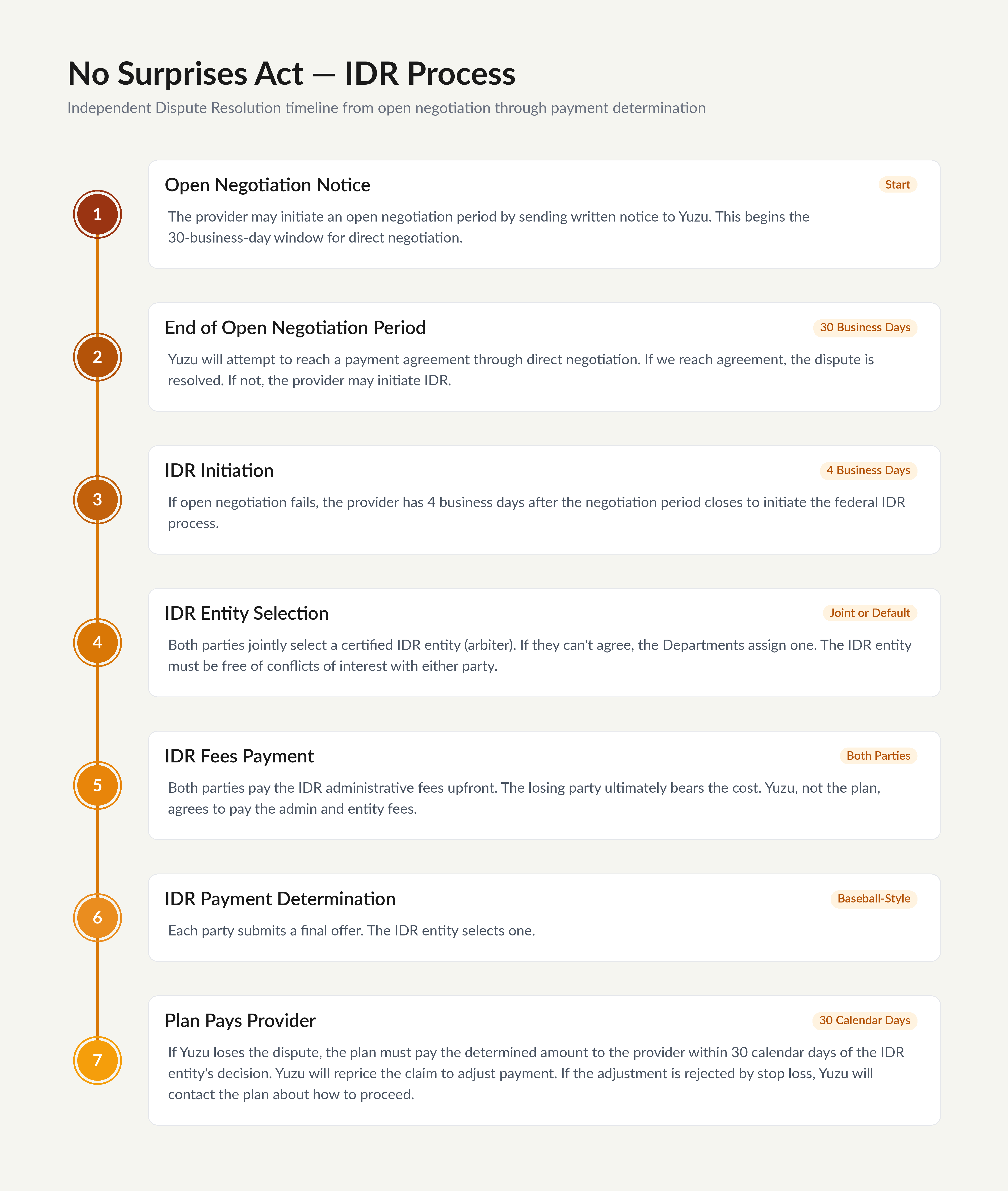
In cases where the payment determination sides with Yuzu, no further action is required. In cases where the payment determination sides with the provider, Yuzu expects groups to pay the provider the full amount of the IDR payment determination. When the payment determination is made, Yuzu reprices the claim to reflect the determination. If the adjusted claim is rejected by stop loss, Yuzu will notify the group to ask how they wish to proceed.
How does the NSA affect Reference-Based Pricing (RBP) plans?
Reference-Based Pricing (RBP) is a cost-containment strategy used by some self-funded health plans where reimbursement rates for medical services are based on a benchmark (such as a percentage of Medicare rates) instead of traditional network-negotiated rates. Since RBP plans often do not have formal provider networks, they can create unique challenges under the No Surprises Act (NSA).
For non-emergency out-of-network services, RBP plans need to ensure that members understand their cost responsibilities. Hospitals and doctors may reject the plan’s payment and seek additional payment from the employer or third-party administrator (TPA). Under NSA, if a provider disputes an RBP plan’s reimbursement, they must go through the Independent Dispute Resolution (IDR) process, instead of billing the patient.
Even if an RBP plan does not have a traditional network, the NSA still prohibits balance billing for emergency services and air ambulance billing. Providers cannot bill patients for the difference between their charge and the RBP plan's allowed amount in NSA-protected cases.
What if I do not want Yuzu to handle Open Negotiations and the IDR process?
If an external vendor is handling your Open Negotiations and IDR process, please reach out to partners@yuzu.health with the contact information for the external vendor. All NSA-eligible EOBs will then be sent with the external vendor’s information instead of Yuzu’s.