

Overview
Health insurance Plans are structured around paying defined benefits based on specified services, equipment, and drugs. There are many reasons that documenting the procedures needed is important:
Ensure IRS Compliance: Employer health benefits have tax advantages, and as a part of this the IRS could require documentation from the employer showing that their health plan spending was actually spent on qualified expenses.
Prevent Fraud: Fraud includes more than just spending on non-qualified expenses but also purchasing healthcare services or goods for non-covered individuals.
Enhance Reporting: Good documentation enhances reports that help employers make smart benefits decisions and see the value in the services you provide.
Protect Members from Surprise Bills: Receipts for services helps Yuzu protect members from duplicate or mysterious charges or bills that may be sent to providers after services are rendered. This can happen even when members are told that they have paid in full for their procedure. Receipts that justify spending protects members from these bills by giving them documentation to contest it.
Documentation needed
Yuzu has several types of cards which are each governed by their approval processes and fund limits. Documentation requirements are based on the type of card that produced the claim but also on the dollar amount of the swipe itself.
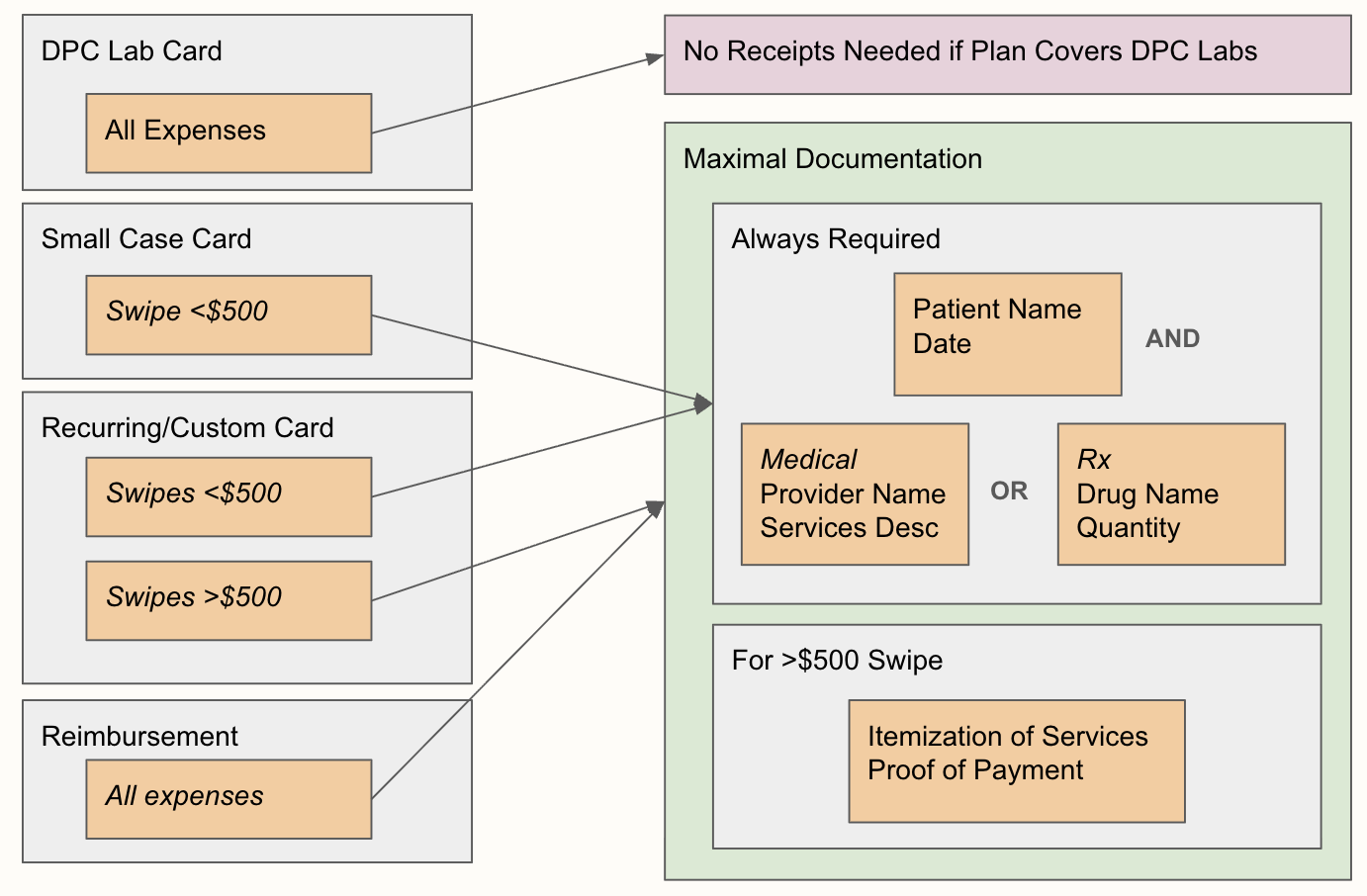
Yuzu understands that Cash Pay would not work if each transaction required the same amount of documentation that is found on a CMS 1500 form. Yuzu has built our requirements to ensure we have enough information about claims to ensure compliance, stoploss trust, and useful documentation.
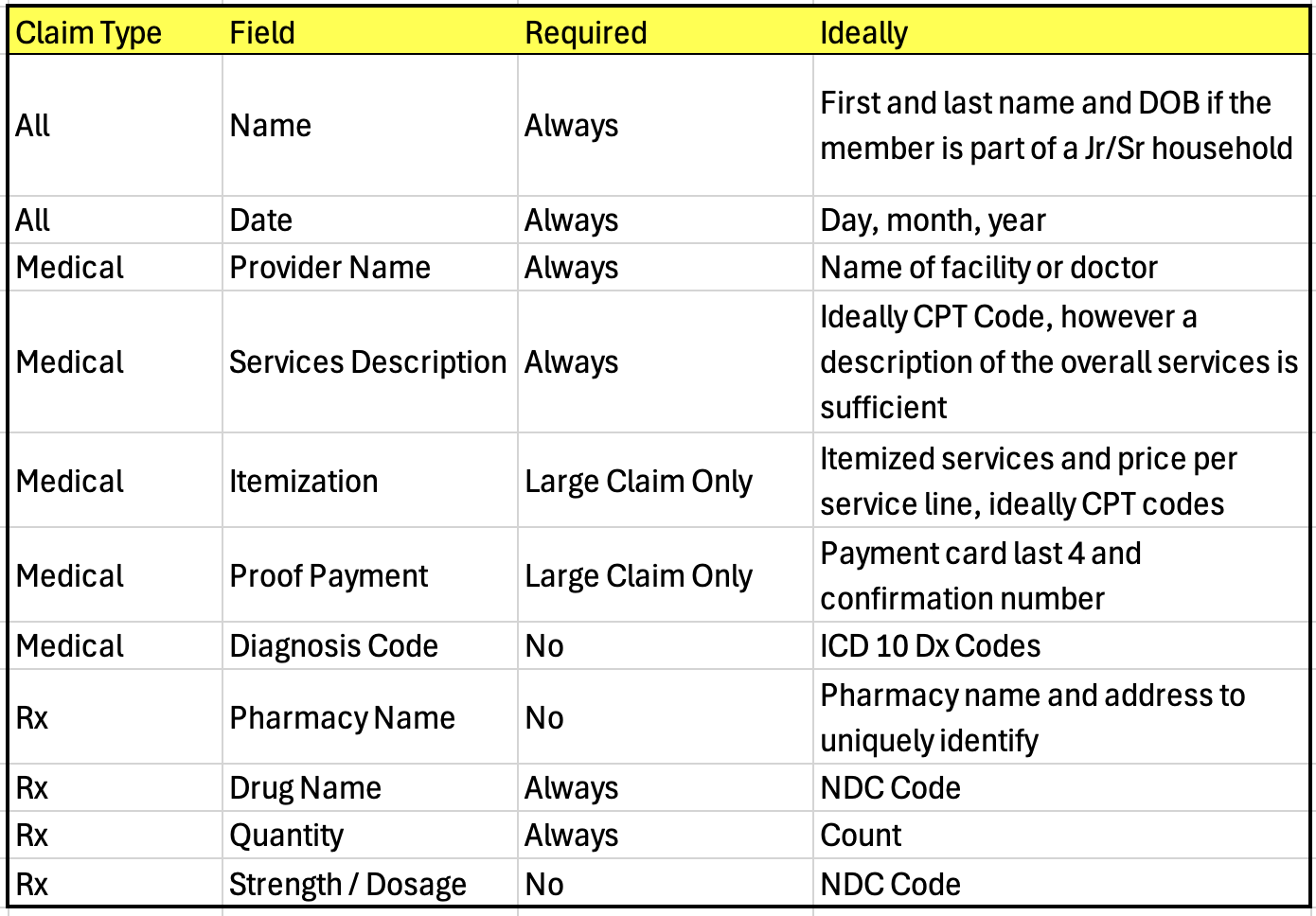
Example: Instead of requiring NPI and TIN for every claim, Yuzu just requires Provider Name.
Example: Instead of requiring an NDC code for every Rx, Yuzu just requires the drug name and quantity.
The below table illustrates definitions:
DPC Lab Cards
Cards that are for DPC lab and ancillary expenses only (typically loaded to max at $150/month) will not require receipts. The proof of spend comes directly from the card data received from Stripe.
Swipes <= $500
Swipes under $500 require only the “Always Required” documentation fields. These are pretty self-explanatory.
Swipes > $500
Swipes over $500 require two additional pieces of information:
Proof of payment. This basically shows that the claim was actually paid. Most receipts will show the last four digits of the card (if paid on a card) or show a payment date.
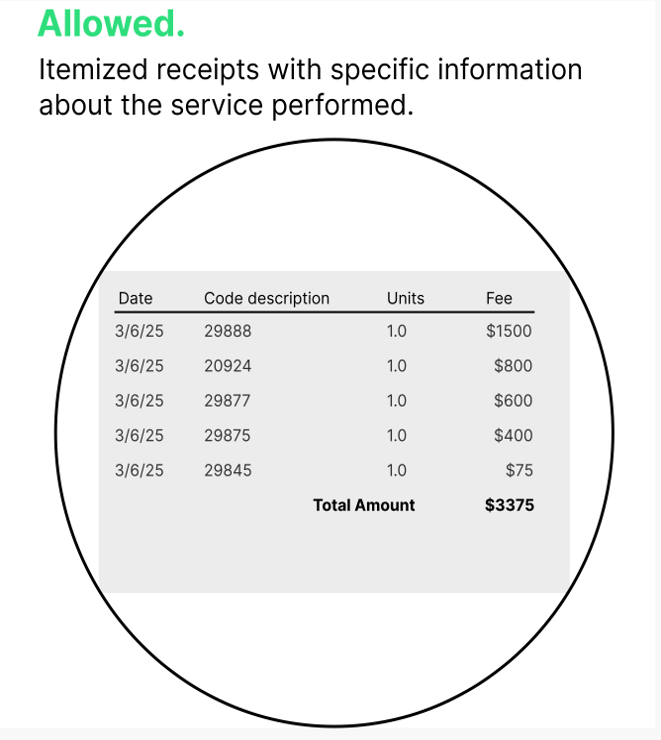
Itemization. This includes a breakdown of the large expense by sub-services. These sub-services are usually CPT codes or descriptions that closely match to CPT codes.
Reimbursements
Reimbursements require the same documentation as swipes over $500. The thinking here is that the member was less supervised when making this transaction and thus getting additional documentation is important.
Exceptions will be made if the member was actively working with a Care Nav, especially if the reimbursement is because of insufficient funds or another preventable cash pay inefficiency.
Enforcement mechanisms
Access to Cash-Pay cards is a privilege to members and is not legally required under ERISA or the Plan Document. Members who do not cooperate and fail to produce receipts may:
Lose access to Cash Pay Cards (Yuzu can turn this off at a member-level)
Have other claims offset by the claim value that is not documented.
E.g. if a member has another payable expense under the plan (whether a manually submitted claim or a provider submitted claim), the member’s responsibility may be increased by up to the value of the un-substantiated cash pay expenses.
The ultimate risk of insufficiently-documented Cash Pay expenses is that the stoploss carrier will not reimburse associated claims. This expense will thus fall on the employer to cover. Employers may try to recoup these funds from Plan Participants (employees) through payroll garnishments.
Yuzu has never had a stoploss carrier reduce claim payment due to an insufficiently documented cash-pay expense. However, there have been several cases where Yuzu has had to work with Care Navigators and members to supply additional itemization on Cash Pay expenses prior to carrier reimbursement.
Having high trust in carrier relationships is part of what makes Cash Pay work. In general, the results of Cash Pay on plan savings are enough of an incentive for Carriers to be reasonable and have leniency. Yuzu communicates to carriers the difficulty of Cash Pay and the fact that there will be situations when even skilled navigators have difficulty getting Cash Pay receipts.